Noctis on Mars

~ A Real Time Virtual Mission To Mars

Noctis on Mars

Tag Archives: JPL

How We Get To Mars: The Ride

08 Friday Jan 2016

Posted by Paul Kiser in Mars, Mars 2016, Science Fiction, Space, Space, Virtual Adventures

≈ Leave a comment

Tags

2016, ESS Carl Sagan, ESS Queen Elizabeth II, Hohmann Transfer, JPL, NASA, space, space travel, spacecraft

Date: Year 1, Sur One, Sol 5 (1.1.5)

There are 36 Quill sections that will be included on the first mission to Mars on the ESS Carl Sagan. An additional 12 sections will make up the ESS Queen Elizabeth II. Since each Core section can hold up to 12 Quill sections, there will be a total of four Core sections, each with 12 Quills. 
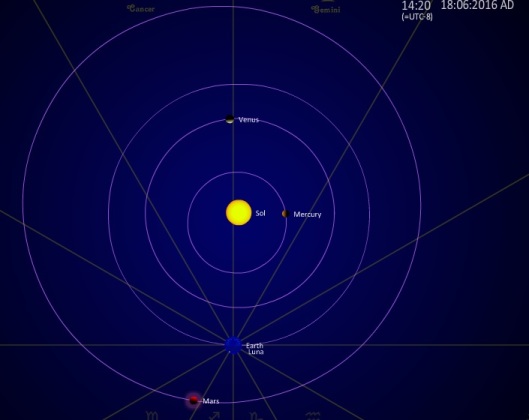
Mars Planet Situation 18 JUN

Planet positions when Mission 2016 reaches Mars

In addition to the Core/Quill sections there will be a Operations and Command section for each ship. There will also be two fuel storage sections, a pulse engine section (PE), a thrust absorption section (TAS). a chemical thrust engine section, four solar arrays, and a auxiliary engineering section for each ship. 

The ESS Queen Elizabeth II will leave Earth orbit on 24 February and the ESS Carl Sagan will leave on 26 February. The unmanned Sagan will accelerate faster and overtake the QEII on 29 February. The two ships will then integrate into one ship over the next few days.

Because of the sectional design of the ships, each craft is named according to the designation of the command section, which is typically the leading section. In the case of integration of two ships, the command section that  is:  1) part of the larger craft, 2) facing forward and, 3) is near the front of the craft, keeps its designation for the entire craft.

During this mission the ESS Carl Sagan will keep the designation through the entire mission. The command section for the ESS Queen Elizabeth II will be docked to the command section of the Sagan and serve as auxiliary command. At some point the command sections of the Sagan and the QEII will both return to Earth when the first crew rotations occur in late 2016 and throughout 2017.

It is important to note that while the Sagan and the QEII prepare to leave orbit, two more ships are being assembled for a Fall 2016 departure. At this time the plan is to send two craft to Mars approximately every six months for foreseeable future. Timing of each mission will depend on the needs of the Mars team and the location of Mars in relation to Earth.

Because we are no longer depending on the Hohmann Transfer, (using the minimum fuel to travel from Earth to Mars and back,) we have fewer issues with launch windows. The average speed of the ESS Carl Sagan will be about 150,000 km/hr. This will put it in orbit around Mars on 18 June. 
Primary Landing Sites

06 Wednesday Jan 2016

Posted by Paul Kiser in Mars, Mars 2016, Space, Space

≈ Leave a comment

Tags

2016, JPL, Mars, NASA, Noctis Labyrinthus, space

Date: Year 1, Sur One, Sol 3 (1.1.3)

(Note: All images thanks to NASA ‘s Mars Trek at http://marstrek.jpl.nasa.gov)Mars Landing Sites 3D

Spain’s exploration of the Americas was anchored by colonies. The location of these colonies were usually determined what was convenient for ship access, but not necessarily convenient for inland access. Veracruz, the first port city in what is now Mexico, was surrounded by steep slopes that prevented easy land routes to and from the port.

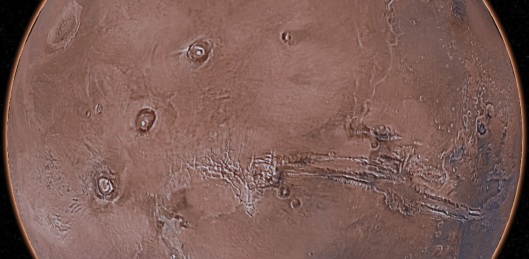
For the exploration of Mars, we have the advantage of having detailed imagery of the entire planet. We also have robotic explorers that have served as ‘boots-on-the-ground,’ for us as we prepared for human development of the planet. Our goal is to find locations on Mars that provide good access to points of scientific, geologic, and possibly archaeological interest.

Mars Landing Sites Large Area

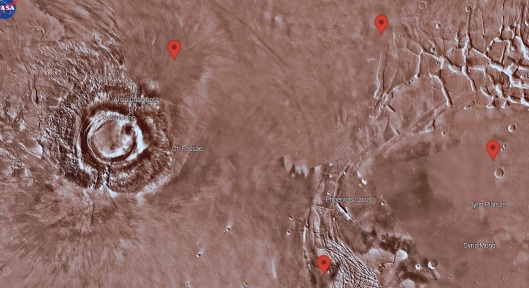
The four primary Mars landing sites

In addition we are looking for places that provide the best possible sites for resources and human habitation. The primary factors influencing our site for human occupation are as follows:

Scientific Value
The driving questions of this mission are:  1) What is the history of Mars?, 2) How did the surface conditions on Mars develop?, 3) What are the challenges to sustaining human occupation of Mars?

The primary landing zone was selected because of the unusual features in the region. It is hoped that by understanding these feature we will answer key questions about Mars and planetary development. 

Mars Landing Sites Group zoom

Mars Landing Sites and Features

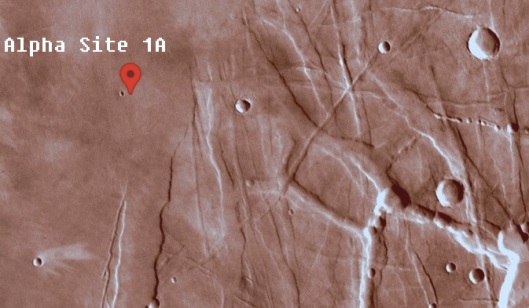
Mars Alpha Site 1A

Mars Alpha Site 1A near Noctis Labyrinthus

Surface Conditions
Many of the features of Mars create barriers to exploring multiple regions. By placing our first Mars base in an area that avoids nearby hazards we can gain maximum access to multiple features.

In addition, landing a spacecraft in an undeveloped area requires a level, uncluttered surface. The final site will be determined as the first craft descends to the surface.

Weather Conditions
Sites nearest the equator were selected to provide the maximum solar benefit and warmest climate.

Mars Beta Site 2A
Mars Landing Site 3A
Mars Landing Site 4A
Newer posts →

Pages

  • About Noctis on Mars
  • Mars Calendar
  • Media Release
  • Mission Objectives
  • Mission Strategy
  • Noctis on Mars – Part 1
    • Chapter 01: Commissioning Day
    • Chapter 02: Admiral’s Mess
    • Chapter 03: Family Crisis
    • Chapter 04: Valentine’s Night
    • Chapter 05: Stowaway
    • Chapter 06: Au Revoir
    • Chapter 07: Assimilated
    • Chapter 08: First Holiday
    • Chapter 09: Under New Management
    • Chapter 10: Secret Cargo
    • Chapter 11: The Smell of Musk
    • Chapter 12: LOS
    • Chapter 13: Night Shift
  • Noctis on Mars – Part 2
    • Chapter 14: The Closer Enemy
    • Chapter 15: FSB
    • Chapter 16: Silent Killer
    • Chapter 17: Putin’s War
  • Project Schedule
  • Verification

Recent Posts

  • For Her Majesty
  • Halfway
  • Homesick
  • Science Project
  • Extreme Mission Makeover

Enter your email address to follow this blog and receive notifications of new posts by email.

Join 5 other subscribers

Recent Comments

Archives

  • April 2016
  • March 2016
  • February 2016
  • January 2016
  • December 2015

Meta

  • Create account
  • Log in
  • Entries feed
  • Comments feed
  • WordPress.com
Follow Noctis on Mars on WordPress.com

Calendar Earth

December 2025
S M T W T F S
 123456
78910111213
14151617181920
21222324252627
28293031  
« Apr    

Recent Posts

  • For Her Majesty
  • Halfway
  • Homesick
  • Science Project
  • Extreme Mission Makeover

Archives

  • April 2016
  • March 2016
  • February 2016
  • January 2016
  • December 2015

Categories

  • Book
  • Earth Space Exploration Program
  • Mars
  • Mars 2016
  • Mars calendar
  • Science Fiction
  • Space
  • Space
  • Uncategorized
  • Virtual Adventures

Create a free website or blog at WordPress.com.

Privacy & Cookies: This site uses cookies. By continuing to use this website, you agree to their use.
To find out more, including how to control cookies, see here: Cookie Policy
  • Subscribe Subscribed
    • Noctis on Mars
    • Already have a WordPress.com account? Log in now.
    • Noctis on Mars
    • Subscribe Subscribed
    • Sign up
    • Log in
    • Report this content
    • View site in Reader
    • Manage subscriptions
    • Collapse this bar
 

Loading Comments...