A Matter of Time

Tags

, , , , , , , ,

Date: Year 1, Sur One, Sol 6 (1.1.6)

If you understand the reason humans created time zones on Earth, you will understand that we have the same need on Mars. On Mars, time zones are divided into 15° segments of longitude.
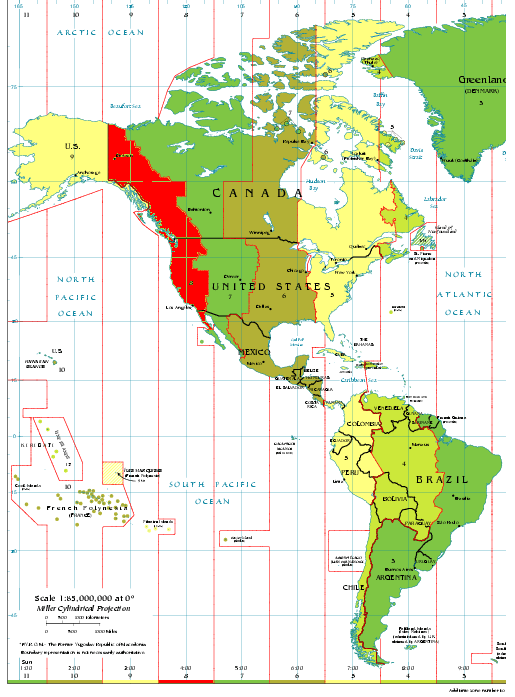
Time Zones on Earth for the Americas

Time Zones on Earth for the Americas

On Earth, the beginning point of all time zones is in Greenwich, England. It was referred to as Greenwich Mean Time (GMT) but is now replaced by Coordinated Universal Time (UTC). Every time zone on Earth is determined by how many time zones or hours it is from Greenwich. For example, Pacific Standard Time (PST) is currently eight hours behind UTC, so it is referred to as UTC -8.

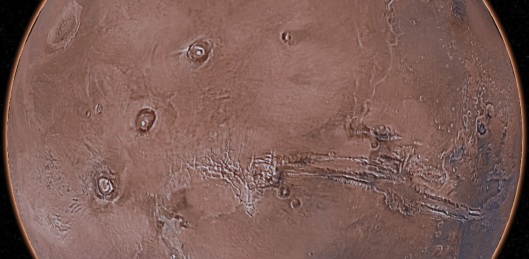
Mars has been given a similar zone zero, like Earth’s UTC zone. It is located at the Airy Crater and that zone is known as Mars Coordinated Time (MTC). Our primary landing site on Mars is the Noctis Labyrinthus which is seven hours behind the Airy Crater or MTC -7.

As I am writing this post, it is 6:11 PM (18:11) PST, 8 January, 2016, on Earth. The time at our primary landing site on Mars is 8:33 AM (08:33) at what we are calling Noctis Standard Time (NST). The date is 6 Sur One, meaning it is the 6th day of the first month of Sur winter.

However, a day on Mars, (the time it takes the planet to make one revolution,) is 2.7% longer than an Earth day (about 40 minutes longer.) This means that at 6:11 PM PST tomorrow, it will NOT be 8:33 NST on Mars. In fact it will be 7:53 NST. To keep Mars on a 24 hour day scientists have devised a time system for Mars by making each second 2.7% longer than an Earth second.

If you are an astronaut on Mars, this is not an issue; however, if you’re a Mars scientist on Earth then you will experience a Mars ‘time creep’ where each Mars day pushes your Earth schedule 40 minutes forward each day.

As more of Mars becomes occupied by humans the time and day length differences will seem more commonplace; however, it can be confusing when someone says it will take 110 days to reach Mars because you have to know if that is Earth days, or Mars days.
How We Get To Mars: The Ride

Tags

, , , , , , , ,

Date: Year 1, Sur One, Sol 5 (1.1.5)

There are 36 Quill sections that will be included on the first mission to Mars on the ESS Carl Sagan. An additional 12 sections will make up the ESS Queen Elizabeth II. Since each Core section can hold up to 12 Quill sections, there will be a total of four Core sections, each with 12 Quills. 

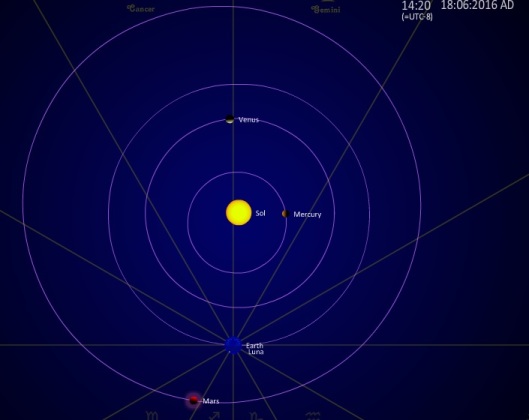
Mars Planet Situation 18 JUN

Planet positions when Mission 2016 reaches Mars

In addition to the Core/Quill sections there will be a Operations and Command section for each ship. There will also be two fuel storage sections, a pulse engine section (PE), a thrust absorption section (TAS). a chemical thrust engine section, four solar arrays, and a auxiliary engineering section for each ship. 

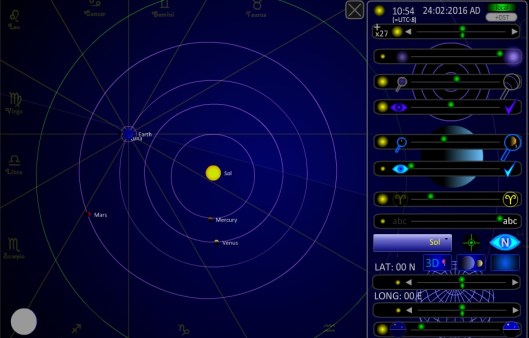
The ESS Queen Elizabeth II will leave Earth orbit on 24 February and the ESS Carl Sagan will leave on 26 February. The unmanned Sagan will accelerate faster and overtake the QEII on 29 February. The two ships will then integrate into one ship over the next few days.

Because of the sectional design of the ships, each craft is named according to the designation of the command section, which is typically the leading section. In the case of integration of two ships, the command section that  is:  1) part of the larger craft, 2) facing forward and, 3) is near the front of the craft, keeps its designation for the entire craft.

During this mission the ESS Carl Sagan will keep the designation through the entire mission. The command section for the ESS Queen Elizabeth II will be docked to the command section of the Sagan and serve as auxiliary command. At some point the command sections of the Sagan and the QEII will both return to Earth when the first crew rotations occur in late 2016 and throughout 2017.

It is important to note that while the Sagan and the QEII prepare to leave orbit, two more ships are being assembled for a Fall 2016 departure. At this time the plan is to send two craft to Mars approximately every six months for foreseeable future. Timing of each mission will depend on the needs of the Mars team and the location of Mars in relation to Earth.

Because we are no longer depending on the Hohmann Transfer, (using the minimum fuel to travel from Earth to Mars and back,) we have fewer issues with launch windows. The average speed of the ESS Carl Sagan will be about 150,000 km/hr. This will put it in orbit around Mars on 18 June. 

The Need for G’s

Tags

, , , , , ,

Date: Year 1, Sur One, Sol 4 (1.1.4)

The International Space Station (ISS) taught us a valuable lesson. Floating around in a weightless environment is not good for the human body. Even with 5 hours of daily exercise astronauts have experienced significant loss of muscle mass. Most of the astronauts studied were in space six months or less, and Mars Mission astronauts will likely spend a year or more in space.

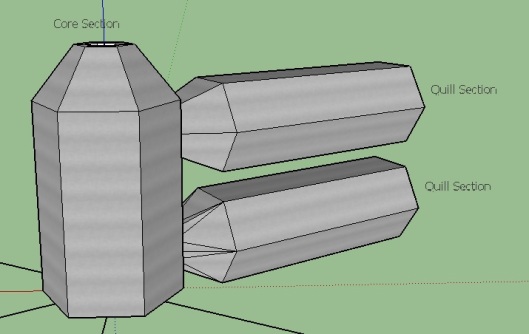
We have the ability to create an artificial gravity by designing our spacecraft to rotate the sections occupied by humans. Our solution to this is to have sections (or ‘quills’) perpendicular to the main core of the craft or station, and have the entire ship rotate on the long axis. This means that an astronaut works and lives in a group of three-story quill sections that provide a gravity environment similar to Earth.

Basic Core/Quill  design

Basic Core/Quill design

In addition, the astronauts exercise every time they climb up into the core, or climb down into another quill. This avoids wasting time on exercising and allows the astronauts to focus on other activities.

Both the ESS Sagan and the ESS QEII have been placed into rotation and are providing a gravity environment for the astronauts and workers preparing the ships for their launches. We are still evaluating the results of gravity environments and their impact on preventing muscle wasting, but the data so far is very encouraging.


Primary Landing Sites

Tags

, , , , ,

Date: Year 1, Sur One, Sol 3 (1.1.3)

(Note: All images thanks to NASA ‘s Mars Trek at http://marstrek.jpl.nasa.gov)Mars Landing Sites 3D

Spain’s exploration of the Americas was anchored by colonies. The location of these colonies were usually determined what was convenient for ship access, but not necessarily convenient for inland access. Veracruz, the first port city in what is now Mexico, was surrounded by steep slopes that prevented easy land routes to and from the port.

For the exploration of Mars, we have the advantage of having detailed imagery of the entire planet. We also have robotic explorers that have served as ‘boots-on-the-ground,’ for us as we prepared for human development of the planet. Our goal is to find locations on Mars that provide good access to points of scientific, geologic, and possibly archaeological interest.

Mars Landing Sites Large Area

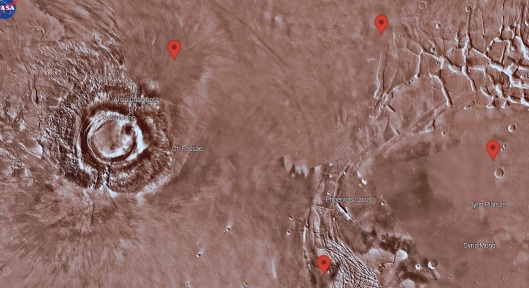
The four primary Mars landing sites

In addition we are looking for places that provide the best possible sites for resources and human habitation. The primary factors influencing our site for human occupation are as follows:

Scientific Value
The driving questions of this mission are:  1) What is the history of Mars?, 2) How did the surface conditions on Mars develop?, 3) What are the challenges to sustaining human occupation of Mars?

The primary landing zone was selected because of the unusual features in the region. It is hoped that by understanding these feature we will answer key questions about Mars and planetary development. 

Mars Landing Sites Group zoom

Mars Landing Sites and Features

Mars Alpha Site 1A

Mars Alpha Site 1A near Noctis Labyrinthus

Surface Conditions
Many of the features of Mars create barriers to exploring multiple regions. By placing our first Mars base in an area that avoids nearby hazards we can gain maximum access to multiple features.

In addition, landing a spacecraft in an undeveloped area requires a level, uncluttered surface. The final site will be determined as the first craft descends to the surface.

Weather Conditions
Sites nearest the equator were selected to provide the maximum solar benefit and warmest climate.

Space Flight Outside the Box

Tags

, , ,

Date: Year 1, Sur One, Sol 2 (1.1.2)

Multiple sections ready to be remotely moved into place for docking

Multiple sections ready to be remotely moved into place for docking

When humans first went to the Moon it was in a panic. A deadline had been set and the best engineering and scientific minds put together a space program that accomplished the goal.

The problem is that the standards established to take us into space are also the reason that we have spent almost 50 years with a space program that has been on idle.

Space programs have tended to design spacecraft to solve one problem. To land on the Moon we designed a craft that could only land on the Moon and lift off again. To live in space we designed modules that were carried into space and put together in one configuration. We designed craft to ferry humans to and from space that only served that function.

The Mars Mission 2016 takes what we have learned in 50 years and designed multi-functioning components that can be configured into a larger space-ferrying craft, such as the ESS Carl Sagan, or into a smaller craft like the ESS Queen Elizabeth II. In Mars orbit the combined ESS Sagan and ESS QEII will be reconfigured into an orbiting space station and a surface habitat that will descend in sections and rebuilt for human occupation.

In addition, we’ve learned some things in 50 years of space travel. One thing we’ve learned is that human activity in space suits is difficult and strenuous. That is why engineers have designed space vehicles that are remote-controlled and self-constructing. Most of the sections of our space vehicles and habitats can put themselves into position, or be programmed to rearrange positions as needed. Human are needed primarily to do the finishing work of connecting wires and hoses in a pressured environment. While humans oversee the activities of the remote sections, they are not required to do almost all of the construction.

This allows us to do more with less in a significantly reduced time span. While one section is docking to another, three more sections can be lining up for docking. A space vehicle with five thirty-foot core sections can have up to 36 ‘quill’ sections attached perpendicular to the core sections. To put them all together takes slightly over three weeks on a cautious schedule.

The Mars Mission 2016, is a reinvention of space travel. It makes the true exploration of space possible.

Mars Sol (Day) One

Mars seasons

Seasons of Mars

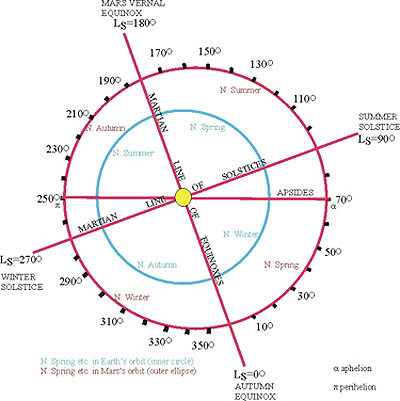
Today, 3 January 2016, is New Years Day on Mars. We have decided that today is a new year on Mars in part because it is the Winter Solstice in Mars’ southern hemisphere (Summer Solstice in the northern hemisphere,) and in part because we are about to launch our first invasion of the Red Planet, which begins a new era for Mars.

Mars Calendar 1.1

Because the marking of time and the creation of a calendar are human needs, we are establishing the Mars calendar using orbital benchmarks that serve the needs of human occupation of Mars.

The calendar begins with the Winter Solstice in each hemisphere, meaning that the first six months (referred to as “Sur”) will coincide with the winter/spring of the southern hemisphere AND will also be the summer/fall calendar for the northern hemisphere. Likewise, the Winter Solstice in the northern hemisphere will begin the final six months (referred to as “Nor”) of Year One AND will also coincide with summer/fall seasons of the southern hemisphere.

Today is the first day of the month of Sur One. We have kept the weeks at seven days and started the calendar on a Sunday; however, because Mars days are between 37 and 39 minutes longer than Earth, Mars will fall behind one day every 36 Earth days.

Our calendar for Mars has 12 months representing one orbit around the Sun, but since Mars takes almost twice as long to orbit the Sun, the months are much longer than an Earth month.

Unlike Earth, we have divided the calendar into three month groups that actually coincide with the two solstices and two equinoxes, therefore, the Mars calendar actually follows the seasons.

However, because the orbital speed of Mars and distance traveled is not uniform through the entire orbit, the four seasons each have a different number of days. This means Sur winter months have about 60 days each, Sur spring months are about 48 days, Nor winter months are about 52 days, and Nor spring months are about 65 days long.

For more information and to see the full Mars calendar go to the Mars Calendar page.

Crew Already in Orbit

Mars launch 24 Feb 2016 zoom

Inner planets position at launch of Mars Mission 2016 on 24 February.

The Mars Mission 2016 is near its launch dates. The Earth Space Ship (ESS) Carl Sagan is assembled and final testing is in process. In a few days the crew will begin final outfitting and prepping of both the ESS Carl Sagan and of the Crew Shuttle known as the ESS Queen Elizabeth II.

Almost all the crew is now in orbit. Final work on the Carl Sagan will be wrapped up by 15 February 2016, leaving only a small team who are not part of the Mars mission on the ship to finish up prep for its unmanned launch on 11 March 2016.

The mission crew will spend the last few days before their 24 February launch training and prepping the Queen Elizabeth II. Most of the mission crew have now been in orbit for at least two months and will spend another seven weeks on either the Sagan, the Queen Elizabeth, or on the Tyson Space Dock.

After both ships launch they will rendezvous and the crew on the Queen Elizabeth II will dock with the Sagan. The Sagan will be using nuclear propulsion to obtain its orbital transfer acceleration to Mars and by remaining unoccupied during the acceleration phase means that the ship can experience g-forces that would endanger the human body.

The crewed Queen Elizabeth will use traditional explosive propulsion and chemical reaction propulsion to accelerate at a reduced rate over a longer period of time. They will have a final thrust in the final day before rendezvous to match speed with the faster moving Sagan.

Once the Sagan reaches Mars orbit most of the ship will remain as a permanent space port. From that platform crews will begin building a habitable environment on the surface of Mars, maintain an ongoing observation and research facility, and support future missions.

The initial mission crew will split into groups, each with a separate focus. One team will be engaged in the surface activities, one team will occupy and maintain the space port, and one team will oversee orbital activities.

A second Orbital Transfer Vehicle (OTV) and Crew Shuttle (CS) are already in the construction phase and will be ready for launch as early as August 2016, but will likely not launch until December. The new ships have a flexible mission and crew that will be finalized as the Mars Mission 2016 is unfolding.

In addition, smaller supply modules are already in orbit in the event of early resupply or mission crisis.

Coming Soon

Mars Mission 2016 is about to be launched. It will be a virtual trip to Mars that will virtually launch on or about 24 February 2016. Leading up to the launch will be information on the design, planning, and preparation for the journey.

Interested in becoming a crew member? After the website goes live there will be a astronaut application form and a list of available positions and requirements for the job.

What does a virtual astronaut have to do? Selected astronauts will be required to research and become knowledgeable about their field. They will be required to publish information on this website on a regular basis to inform the rest of the crew and people following along with the adventure.

Crew members will fall into one of the following age groups and some positions will oversee the work of others. The age categories are:

  • Under 11 years old
  • 11 to 14 years old
  • 15 to 18 years old
  • Over 18 years old

The mission will go live in early January 2016.