Noctis on Mars

~ A Real Time Virtual Mission To Mars

Noctis on Mars

Tag Archives: spacecraft

Blast Propulsion

19 Tuesday Jan 2016

Posted by Paul Kiser in Earth Space Exploration Program, Mars, Mars 2016, Science Fiction, Space, Space, Virtual Adventures

≈ Leave a comment

Tags

2016, artificial gravity, blast propulsion, electrostatic generator, ESS Carl Sagan, ESS Queen Elizabeth II, friction generator, gravity, Hohmann Transfer, ICP, Impulse Cycle Propulsion, JPL, Mars, Mars Mission 2016, NASA, nuclear pulse, propulsion, rocket, rocket propulsion, shock absorber, space, space travel, spacecraft

  • Mars Date/Time:  Year 1, Sur One, Sol 16 (1.1.16)  9:24 PM NST
  • Earth Date/Time:  19 January 2016  2:00 PM PST

Both the ESS QE II and the ESS Sagan are have blast propulsion, known as Impulse Cycle Propulsion (ICP). This consists of a series of explosions behind the ship that push it forward.

Mars Pulse Engine Drive

Artist rendition of a Blast Propulsion Drive

Each bomb, or pellet is pushed out of the engine section of the ship and is attached be a wire or tether. When the pellet reaches the correct distance the tether pulls taught and signals the ship. At that millisecond the computer on the ship sends the detonation code to the pellet and it explodes. The strength of the explosive force on the ship is determined by the pellet type and size, and the length of the tether. Acceleration of the ship is determined by explosive force and the frequency of pellet deployment.

The engine section consists of a blast plate and blast umbrella that absorbs most of the blast. The blast plate and umbrella is connected to the ship by sixteen resistance rods, or shock absorbers, that both cushion the shock of the pellet detonation and generate power using electrostatic generators on each rod that produce electricity from friction.

The blast umbrella plates also have electrostatic generator shock absorbers rods that also generate electricity for the ship as well as absorb more of the pellet blast to propel the ship.

The ship also has the more traditional chemical-based engines to correct and alter course. Each Quill section has it’s own engine and it is tied into the Command section. The engines on the Quill sections are primarily for landing on Mars. 

Acceleration of the ESS QE II is designed for 9.81 meters per second per second, which is equal to 1 g (the same gravity force of Earth at sea level.) It can accelerate up to 2 g; however, the needed speed to accelerate to 150,000 km/hr (41.67 km/s) only requires 4.25 seconds of acceleration at 1 g, so 2 g acceleration is not needed. In fact, the QE II will accelerate to 45,000 km/hr on the first day, then evaluate the ship’s performance. It will then accelerate to 100,000 km/hr on the third day, and then match speed with the ESS Sagan on the six day.  

The ESS Sagan will leave orbit two and a half days after the QE II departs, but will accelerate to 150,000 km/hr over a 12 hour period. It will overtake the QE II. The QE II will disassemble and recombine with the Sagan creating one larger ship. The combined ships will continue their 110 day trip to Mars. Other than course corrections, the ships will not use the ICP engine again until it is time to decelerate for Mars orbit.
Death In Space?

17 Sunday Jan 2016

Posted by Paul Kiser in Earth Space Exploration Program, Mars, Mars 2016, Science Fiction, Space, Space, Virtual Adventures

≈ Leave a comment

Tags

2016, crisis, death, JPL, losing a crew member, loss, Mars, Mars Mission 2016, memorial, NASA, space, space travel, spacecraft


  • Mars Date/Time:  Year 1, Sur One, Sol 14 (1.1.14)  10:40 PM NST
  • Earth Date/Time:  17 January 2016  2:00 PM PST

There were 27 people on the nine Apollo missions that went to Moon. We will exceed that total in our first mission to Mars. The total time for all the Apollo Moon missions was 91 days. The crew of the ESS Carl Sagan won’t even reach Mars in that time. The Apollo missions were all considered high risk, and one mission to the Moon almost lost three crew members. Our missions elevate that risk by a factor of ten.

background_memorial

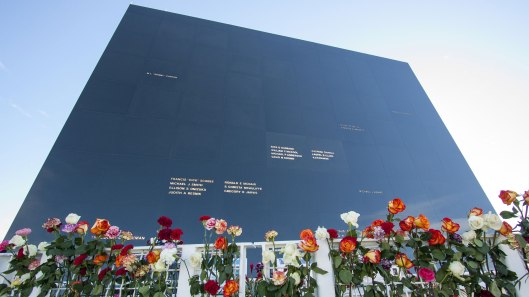
NASA Memorial to the 24 astronauts who gave their lives in service to the United States Space Program

We will do everything in our power to prevent anyone dying in space; however, with crews of 28 astronauts or more, most of whom will be in space for over two years, death is a real possibility. All crew members know that losing a fellow astronaut is part of the risk of space travel and like every other potential crisis, we plan for the possibility.

If a crew member dies in mission and their body is recoverable, the body will be cremated. Each crew member has declared what they wish to be done with their ashes, and every effort will be made to honor their request. The Counselor and Captain will designate someone to collect the personal items of that crew member and pack it for return to Earth.

Assuming the mission is not in a crisis, the crew members will be follow a ‘significant loss’ protocol (also used for crew members before and after their crewmates return to Earth) that involves formal and informal discussion, remembrance , and ceremony of that crew member or members.

All crew members who had a significant relationship with the deceased crew member(s) will have counseling and evaluation. If the loss is too difficult for a crew member they will be reassigned and/or scheduled for return.

There is no way to know how much the loss of a crew member(s) will impact a mission; however, the Captain and Counselor have broad authority to make adjustments and reassignments after the loss of crew.

The Earth/Mars Dance

16 Saturday Jan 2016

Posted by Paul Kiser in Earth Space Exploration Program, Mars, Mars 2016, Science Fiction, Space, Space, Virtual Adventures

≈ Leave a comment

Tags

2016, ESS Carl Sagan, ESS Queen Elizabeth II, head orbital transfer, Hohmann Transfer, JPL, Mars, Mars Mission 2016, NASA, space, space travel, spacecraft, up orbital transfer

  • Mars Date/Time:  Year 1, Sur One, Sol 13 (1.1.13)  11:19 PM NST
  • Earth Date/Time:  16 January 2016  2:00 PM PST

Any journey begins with a beginning point and an ending point. Our journey to Mars is no different; however, in this case the beginning point and the ending point are in motion and the distance between them varies depending on where each planet is in their orbit.

Launch Day
Launch Day
Closest Approach
Closest Approach

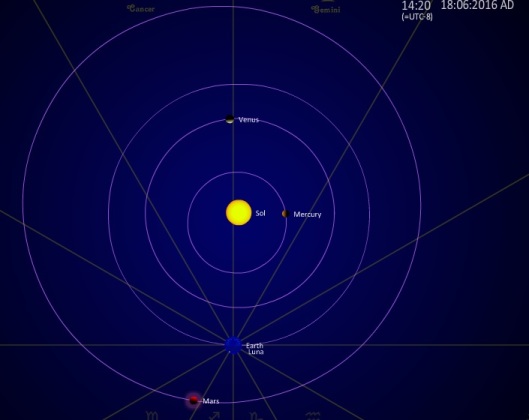
Mars and Earth will be at their closest point on 30 May 2016. To take advantage of this the ESS Queen Elizabeth II and the ESS Carl Sagan will depart for Mars in late February and arrive in June. We call this a “up” orbital transfer because the ships are coming up from behind the planet to meet it in its orbit.

However, we will also be using a “head” orbital transfer in future missions. This is when the departure planet is ahead of the destination planet. It requires more fuel in most cases; however, it gives us more opportunities to send ships between the two planets. The next three missions to Mars will be using the head orbital transfer.

Because Earth moves faster than Mars, an up orbital transfer to Earth is impractical once it is ahead of Mars in orbit. For this reason the first return mission to Earth will be a ‘head’ orbital transfer in April 2017, and that mission won’t arrive at Earth until November 2017.

Earth Space Exploration Program

15 Friday Jan 2016

Posted by Paul Kiser in Earth Space Exploration Program, Mars, Mars 2016, Science Fiction, Space, Virtual Adventures

≈ Leave a comment

Tags

2016, Earth Space Exploration Program, ESEP, international, JPL, Mars, Mars Mission 2016, NASA, space, space travel, spacecraft

  • Mars Date/Time:  Year 1, Sur One, Sol 12 (1.1.12)  11:56 PM NST
  • Earth Date/Time:  15 January 2016  2:00 PM PST

ESEP logoThe Mars Missions are government funded operations from 23 different member countries that established the Earth Space Exploration Program (ESEP). Each country must fund two years of operations in advance, and must commit to funding for an additional five years. Current annual funding (2016) is $850 million/per country/per year and it increases by $50 million each year.

The countries are as follows:

  • Australia
  • Brasil
  • Canada
  • Chile
  • China (中国)
  • India (इंडिया)
  • Indonesia
  • Italy (Italia)
  • Germany (Deutschland)
  • France
  • Japan (日本)
  • Mexico (Méjico)
  • Netherlands (Nederland)
  • Nigeria
  • Panamá
  • Perú
  • Philippines (Pilipinas)
  • Saudi Arabia (المملكة العربية السعودية)
  • South Korea (대한민국)
  • Spain (España)
  • Thailand (ประเทศไทย)
  • United Kingdom
  • United States of America

No one country has more authority than any other and only scientists are allowed to be on the governing body. Russia is notably absent from the program because they did not accept the seven year funding commitment and the equal partnership of the member countries. China and the United States also hesitated; however, both countries found the funding formula allowed them to continue most of their current space programs, while taking part in the most significant space exploration effort in history.

The program is not a plan of several individual missions, but rather it is a series of overlapping missions with some people staying on Mars, while others return to Earth. Decisions of who is to stay and who will return are to be made in the months leading up to a return mission. In the case of the first mission, it is expected that only one-quarter to one-third of the crew will be members of the first return mission.

At least fifty percent of the crew from each mission will remain at Mars (on the surface or in orbit.) At least another twenty-five percent will remain longer than two return-to-Earth missions. Any crew members remaining at or on Mars for more than two return-to-Earth missions will have priority for the next return mission; however, no one is required to return to Earth unless the Mission Commander, the Mission Counselor, or the Mission Physician orders them to return.

The goal of the Earth Space Exploration Program is to follow the example of the International Space Station and provide ongoing occupation and exploration of Mars. It is projected that by the end of the first year on Mars we will have tripled our knowledge and understanding of space, space travel, living in space, and of the planet. By the end of the second year we will have doubled that knowledge of the first year, and by the end of the third year we will have a permanent, self sufficient, residency on Mars that will have established its own social, economic, and political identity. 

Decades ago Carl Sagan said, “Space calls to us…” We believe it’s time we answered that call.

What Time Is It?

14 Thursday Jan 2016

Posted by Paul Kiser in Mars, Mars 2016, Science Fiction, Space, Space, Virtual Adventures

≈ Leave a comment

Tags

2016, JPL, Mars, Mars Mission 2016, Mars time, NASA, Noctis Labyrinthus, Noctis Standard Time, NST, Pacific Standard Time, PST, space, space travel, spacecraft, Time

  • Mars Date/Time:  Year 1, Sur One, Sol 12 (1.1.12)  12:36 AM NST
  • Earth Date/Time:  14 January 2016  2:00 PM PST
There are several versions of Mars Clock apps

There are several versions of Mars Clock apps

As humans expand their reach, time becomes a major issue. Before the invention of machines that could transport people over long distances in a short time period, all time was local. When the Sun was directly overhead in a village, it was noon.

However, as transportation and communication advanced, so did our recognition that the time of day was different depending on the location. The railroads in Europe were the first to establish a ‘standard time’ that later became know as Railway Time.

However, with space travel, a time standard based on Earth isn’t compatible with keeping time on another planet. We’ve already discussed this issue in a previous article (SEE: A Matter of Time,) but there is more to this issue than just when the Sun rises and sets on two different planets.

The Mars Mission has four Earth-based Operation Control locations. (San Jose, California, USA; Kumamoto, Kumamoto Prefecture, Japan 熊本市; and the twin Operation Centers in Figueres, Spain and Perpignan, France.) In addition, we have our launch facility near Arica, Chile. For simplicity the workers and crew have been on Pacific Standard Time; however,  on 30 January all mission operations on Earth, and in orbit will switch to Mars Noctis Standard Time (NST.)

This will eliminate confusion by Earth-based operations as to what time it is for the Mars Alpha Base (once it is established) and avoid interruptions during their sleep cycle. As teams for previous robotic missions to Mars have known, this creates and odd situation for them, because of a forty-minute difference between a day on Earth and a day on Mars. All Mars Operation Control locations will be on shifts of six hours and ten minutes each (plus a one hour briefing before each shift,) with the next day beginning 40 minutes later.

For the crew and the support staff of the Mars Mission, the question: “What time is it?” will require knowing what time it is on Mars at that moment.

Crew Training and Alert Drills

13 Wednesday Jan 2016

Posted by Paul Kiser in Mars, Mars 2016, Science Fiction, Space, Space, Virtual Adventures

≈ Leave a comment

Tags

2016, Alerts, Code Alerts, Crew Status, Crew training, ESS Carl Sagan, ESS Queen Elizabeth II, JPL, Mars, Mars Mission 2016, NASA, space, space travel, spacecraft

  • Mars Date/Time:  Year 1, Sur One, Sol 11 (1.1.11)  1:16 AM NST
  • Earth Date/Time:  13 January 2016  2:00 PM PST

The ESS Queen Elizabeth II will depart Earth orbit in exactly six weeks. Currently the 28 crew members are in orbit preparing both the ESS QE II and the ESS Carl Sagan for departure.

In the next few weeks the crew will be stocking the ship with the more perishable items, perform final tests on ship systems, and conduct training aboard both ships.

Our emergency codes are not to prepare for battle, but to save lives

Our emergency codes are not to prepare for battle, but to save lives

Part of the training will be drills in the event of a crisis. Each crew member is assigned areas of responsibilities in an emergency. In some situations the crew members will be required to seal up the compartment they are in and shelter-in-place; however, some situations will require all crew members to take action to resolve the crisis as quickly as possible.

Among the emergency codes are:

Code Command – All Command Staff are to report in to the Command Module and/or move to that section. All other staff is to stand by for further instructions. (Normally for a crisis requiring an immediate decision from the Command Staff regarding an imminent threat to ship or crew.)

Code Alert – All crew members report to assigned stations, secure the area and await further instructions. Code Alert is also the call to prepare to abandon the ship.

Code Med (Location) – Medical staff to identified area.

Code Tag – All team members call or report to their Director or Commander immediately.

Code Air (Location) – Pressure leak within the ship or habitat or other environmental threat that may endanger the crew and/or ship. Each member to seal doors, report, and await instructions.

Code Fire (Location) – A fire or threat of fire exists. A crew members are trained to take specific actions based on the location of the fire.

Code Green – A threat to the Botanical section of the ship or habitat. Usually this would be a computer generated alert when sensors indicate a severe problem.

Mars Alpha Landing Sites

13 Wednesday Jan 2016

Posted by Paul Kiser in Mars, Mars 2016, Science Fiction, Space, Space, Virtual Adventures

≈ Leave a comment

Tags

2016, Cráter de Tormenta, JPL, Landing sites, Mars, Mars Mission 2016, NASA, Noctis Labyrinthus, space, space travel, spacecraft, Storm Crater

Date: Year 1, Sur One, Sol 10 (1.1.10)

Alpha Landing Sites

The Alpha Landing Sites near Noctis Labyrinthus (Image credit: Mars Trek/NASA)

A few days ago we announced the four possible landing zones on Mars. Today we are looking at the primary zone (Alpha) and the four possible landing sites within that zone. These for sites will have to be eliminated by the crew before they would consider landing at any of the three other sites.

The Alpha sites are located in a transition region between the Tharsis Volcanic Plateau and Noctis Labyrinthus. The first Mars landing site will likely become a major hub for exploring the features in a 2,000 kilometer radius around it. Access to and from the site will be important, and the Alpha sites have been selected with that in mind.

In addition, a community as large as 500 scientists may be living at the Alpha landing site within eight years, so a roughly level area with room to expand is vital to the first ‘city’ on Mars.

Alpha Site 1A and 1B are located near a small impact crater west of Noctis Labyrinthus. This crater has been designated as Cráter de Tormenta or Storm Crater. The 200 meter deep crater will give scientists immediate access to areologic (geologic) information about the area. The crater may also play a role in development of the colony by providing sloped areas with good exposure to the Sun for solar panels and the botanical structures.

The details of each site are as follows:

    Site           Elevation   Longitude  Latitude  Distance from 1A

Alpha 1A       6,483 m      -108.58°       -4.61°

Alpha 1B       6,504 m      -108.66°       -4.54°                 6.4 km

Alpha 1C       6,513 m      -108.34°       -5.06°                34.0 km

Alpha 1D      6,496 m      -108.37°       -4.72°                13.5 km

No Windows = A Better View

11 Monday Jan 2016

Posted by Paul Kiser in Mars, Mars 2016, Science Fiction, Space, Space, Virtual Adventures

≈ Leave a comment

Tags

2016, crew morale, ESS Carl Sagan, ESS Queen Elizabeth II, HD cameras, High Definition, JPL, Mars, Mars Mission 2016, Monitors, NASA, space, space travel, spacecraft, spacecraft design, windows

Date: Year 1, Sur One, Sol 9 (1.1.9)

Windows are a relic of primitive space travel. When building a spacecraft in the 20th century the astronauts had to see outside the ship, so windows were installed. They had to be a heavy, thick, and transparent material because the lack of pressure outside meant that any normal window would explode.

Windows on ISS

Windows on the International Space Station (ISS)…great when there is something to look at, but not so much in the black of space

Windows didn’t help the astronauts see any better than normal vision and restricted the view to the direction the window faced. Windows also didn’t record the view, so the benefit of a window was completely dependent on an astronaut looking out of it.

When Neil Armstrong dirtied his boots on the Moon, everyone else saw a grainy image of shadows and light that looked vaguely like something hopping down a pole. Today, a moon landing today would have three or four high-definition (HD) cameras fixed on an astronaut’s descent down the ladder, and there might even be a drone with a camera using thrusters hovering over the event. We would watch in amazement on an HD screen that would make us feel like we were there on the Moon, looking through a window at the historical moment.

The fact is that using today’s HD cameras gives us a better view than any window ever designed. In addition, we can use cameras that can see in the dark, and see in different wavelengths of light outside of normal human vision.

Designing a spacecraft with windows makes no sense when cameras can provide better imaging and can do more than the human eye. For that reason we have almost no windows on our ships, and we have a better view of the outside.

No fewer than eight cameras provide our command ships with a forward view. Each of those cameras can be tilted, panned, and zoomed. Normally all eight cameras are focused ahead with approximately the same view. Four of the eight cameras ‘see’ in a different wavelength than the visible spectrum and all eight cameras can be used to look at independent views.

In addition we have over 50 cameras on the core section that give a 360°/360°/360° (X/Y/Z axis) view of the ship and it’s surroundings. The Quills each have 24 outside cameras that, like the cameras on the Core Sections, can be viewed by anyone, on any monitor on the ship.

The Command Deck is an array of monitors that allow the crew to visually observe the outside of the spacecraft, however, the system is not dependent on a crew member staring at a monitor. Computer programs track and alert the crew of any unusual movement outside and/or near the ship using a broad light spectrum and radar. The view of each camera on the ship is recorded and can also be accessed after an event that requires investigation. 

However, the crew will not have much to look at during the transfer from Earth to Mars. Months of looking at a mostly black background would likely reinforce the isolation of the astronauts. To address this issue, interior monitors can also be switched over to recorded video of a landscape or place that will give an astronaut a sense of being back on Earth. 

There are three windows in each Command Module that will allow human eye observation of the outside; however, it is unlikely that they will be of much use to the crew until they are in orbit above Mars. Even then, the camera system will give better, more detailed images than the windows will provide.

Mars Mission 2016: The Crew

11 Monday Jan 2016

Posted by Paul Kiser in Mars, Mars 2016, Science Fiction, Space, Space, Virtual Adventures

≈ Leave a comment

Tags

2016, areography, astronauts, biology, botany, communications, engineering, ESS Carl Sagan, ESS Queen Elizabeth II, JPL, Mars, Mars Mission 2016, NASA, physician, science, space, space travel, spacecraft

Date: Year 1, Sur One, Sol 8 (1.1.8)

The finalized crew of the Mars Mission 2016 has been announced. There is still the possibility of changes in the next few weeks; however, at this time these are the 28 primary crew members that are training for the 24 February departure.MM2016 Org Chart

(NOTE:  EMT = Estimated Mission Time)

Mission Commander – Jenna Wade (EMT:  27 months)
Jenna will command all aspects of the mission and will be stationed at Mars Alpha Base (2nd Landing.)

Team

  • Lanny Deaton-Science Director
  • Roman Guzman – Engineering Director
  • Naomi Pierce – Communications Director
  • Ken Hart – Captain/Mars Port Commander
  • Wendy Stevens – Counselor
  • Kayla Summers – Physician 

Science Director – Lanny Deaton (EMT:  27 months)
Lanny will oversee all science programs for the mission and will be stationed at Mars Alpha Base (1st landing.)

Team

  • Steve Conner-Areology Officer
  • Jacob Reese-Archeology Officer
  • Alexander Rivera-Biology/Environment Officer
  • Sying Wang-Botany Specialist
  • Heidi Massey-Botany Specialist

Engineering Director – Roman Guzman (EMT:  27 months)
Roman will direct all construction, maintenance, and repair during the mission and will be stationed at Mars Alpha Base (1st landing.)

Team

  • Lanita Case-Engineering Officer
  • Jeramy Prater-Munitions Officer
  • Tory Hankins-Plant Officer
  • Ling Cho-Logistics Officer
  • Abdul Karem-Logistics Specialist

Communication Director – Naomi Pierce (EMT:  27 months)
Naomi will oversee all communications, data collection, and mission reporting and will be stationed on the Mars Port in orbit.

Team

  • Paige Flores-Comm Officer
  • John Schultz-Comm Specialist
  • Krista Parker-Comm Specialist
  • Jennifer Nagi-Data/Record Specialist

Captain ESS QEII/Sagan, Mars Port Commander – Kenneth Hart (EMT:  27 months)
Ken will Captain the ESS Queen Elizabeth II, then take command of the ESS Carl Sagan when the ships merge. Upon arrival at Mars he will become the Commander of the Mars Port and be stationed there.

Team

  • Ann Flores-First Officer/Mars Orbit Control Director
  • Dane Paris-Pilot

Mission Physician – Kayla Summers (EMT:  27 months)
Kayla oversee and monitor the health of the mission crew and she will be stationed at the Mars Alpha Base (2nd landing.)

Team

  • Jai Wong-Nurse Practitioner
  • Alberto Sowers-Nutritional Officer

Counselor – Wendy Stevens (EMT:  27 months)
Wendy will assess the mission crew on an ongoing basis and will make recommendations for crew changes, mission assignments, and crew returns. Wendy will be stationed at the Mars Alpha Base (2nd landing.)

Team

  • Ian Banks-MET Reserve
  • Peyton Rhodes-SKY Reserve

How We Get To Mars: The Ride

08 Friday Jan 2016

Posted by Paul Kiser in Mars, Mars 2016, Science Fiction, Space, Space, Virtual Adventures

≈ Leave a comment

Tags

2016, ESS Carl Sagan, ESS Queen Elizabeth II, Hohmann Transfer, JPL, NASA, space, space travel, spacecraft

Date: Year 1, Sur One, Sol 5 (1.1.5)

There are 36 Quill sections that will be included on the first mission to Mars on the ESS Carl Sagan. An additional 12 sections will make up the ESS Queen Elizabeth II. Since each Core section can hold up to 12 Quill sections, there will be a total of four Core sections, each with 12 Quills. 

Mars Planet Situation 18 JUN

Planet positions when Mission 2016 reaches Mars

In addition to the Core/Quill sections there will be a Operations and Command section for each ship. There will also be two fuel storage sections, a pulse engine section (PE), a thrust absorption section (TAS). a chemical thrust engine section, four solar arrays, and a auxiliary engineering section for each ship. 

The ESS Queen Elizabeth II will leave Earth orbit on 24 February and the ESS Carl Sagan will leave on 26 February. The unmanned Sagan will accelerate faster and overtake the QEII on 29 February. The two ships will then integrate into one ship over the next few days.

Because of the sectional design of the ships, each craft is named according to the designation of the command section, which is typically the leading section. In the case of integration of two ships, the command section that  is:  1) part of the larger craft, 2) facing forward and, 3) is near the front of the craft, keeps its designation for the entire craft.

During this mission the ESS Carl Sagan will keep the designation through the entire mission. The command section for the ESS Queen Elizabeth II will be docked to the command section of the Sagan and serve as auxiliary command. At some point the command sections of the Sagan and the QEII will both return to Earth when the first crew rotations occur in late 2016 and throughout 2017.

It is important to note that while the Sagan and the QEII prepare to leave orbit, two more ships are being assembled for a Fall 2016 departure. At this time the plan is to send two craft to Mars approximately every six months for foreseeable future. Timing of each mission will depend on the needs of the Mars team and the location of Mars in relation to Earth.

Because we are no longer depending on the Hohmann Transfer, (using the minimum fuel to travel from Earth to Mars and back,) we have fewer issues with launch windows. The average speed of the ESS Carl Sagan will be about 150,000 km/hr. This will put it in orbit around Mars on 18 June. 

Newer posts →

Pages

  • About Noctis on Mars
  • Mars Calendar
  • Media Release
  • Mission Objectives
  • Mission Strategy
  • Noctis on Mars – Part 1
    • Chapter 01: Commissioning Day
    • Chapter 02: Admiral’s Mess
    • Chapter 03: Family Crisis
    • Chapter 04: Valentine’s Night
    • Chapter 05: Stowaway
    • Chapter 06: Au Revoir
    • Chapter 07: Assimilated
    • Chapter 08: First Holiday
    • Chapter 09: Under New Management
    • Chapter 10: Secret Cargo
    • Chapter 11: The Smell of Musk
    • Chapter 12: LOS
    • Chapter 13: Night Shift
  • Noctis on Mars – Part 2
    • Chapter 14: The Closer Enemy
    • Chapter 15: FSB
    • Chapter 16: Silent Killer
    • Chapter 17: Putin’s War
  • Project Schedule
  • Verification

Recent Posts

  • For Her Majesty
  • Halfway
  • Homesick
  • Science Project
  • Extreme Mission Makeover

Enter your email address to follow this blog and receive notifications of new posts by email.

Join 5 other subscribers

Recent Comments

Archives

  • April 2016
  • March 2016
  • February 2016
  • January 2016
  • December 2015

Meta

  • Create account
  • Log in
  • Entries feed
  • Comments feed
  • WordPress.com
Follow Noctis on Mars on WordPress.com

Calendar Earth

December 2025
S M T W T F S
 123456
78910111213
14151617181920
21222324252627
28293031  
« Apr    

Recent Posts

  • For Her Majesty
  • Halfway
  • Homesick
  • Science Project
  • Extreme Mission Makeover

Archives

  • April 2016
  • March 2016
  • February 2016
  • January 2016
  • December 2015

Categories

  • Book
  • Earth Space Exploration Program
  • Mars
  • Mars 2016
  • Mars calendar
  • Science Fiction
  • Space
  • Space
  • Uncategorized
  • Virtual Adventures

Create a free website or blog at WordPress.com.

Privacy & Cookies: This site uses cookies. By continuing to use this website, you agree to their use.
To find out more, including how to control cookies, see here: Cookie Policy
  • Subscribe Subscribed
    • Noctis on Mars
    • Already have a WordPress.com account? Log in now.
    • Noctis on Mars
    • Subscribe Subscribed
    • Sign up
    • Log in
    • Report this content
    • View site in Reader
    • Manage subscriptions
    • Collapse this bar
 

Loading Comments...